
Programme Ecosystem Model
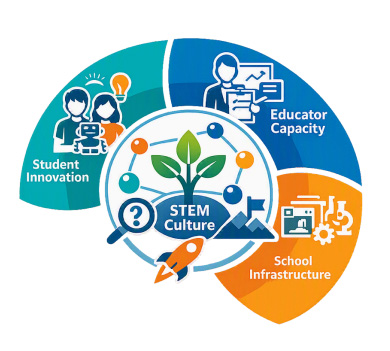
Our programme ecosystem is built around three simple pillars: students learn by doing, teachers are equipped to guide learning, and schools provide the spaces and systems that make STEM sustainable.
Students
Students explore, design, build, and present STEM projects through hands-on activities.
Teachers
Teachers receive training, lesson support, and practical tools to lead STEM learning confidently.
School
The school provides labs, resources, schedules, and leadership support to keep the programme active.
Result: A simple, sustainable STEM ecosystem where students create, teachers guide, and the school grows a culture of innovation.
Implementation Roadmap
Needs Assessment
Review curriculum, infrastructure, teacher readiness, student interests, and desired outcomes.
Programme Design
Create a customised learning plan with modules, timelines, resources, and grade-wise objectives.
Teacher Orientation
Train educators on facilitation, safety, classroom management, assessment, and interdisciplinary integration.
Student Engagement
Run workshops, projects, competitions, design challenges, and collaborative problem-solving activities.
Review and Scale-Up
Evaluate feedback, student work, teacher observations, and school goals to plan the next phase.
Expected Outcomes
Input
Students, teachers, school leadership, STEM resources, and learning spaces.
Learning Experience
Workshops, modules, lab sessions, design challenges, mentoring, and project showcases.
Immediate Output
Student projects, teacher confidence, active classrooms, and visible innovation work.
Long-Term Outcome
Future-ready learners, empowered educators, and a strong school-wide STEM culture.
| Outcome Area | What Improves | What Schools Can Observe |
|---|---|---|
| Students | Curiosity, scientific thinking, creativity, teamwork, problem solving, communication, and confidence. | Students ask better questions, build prototypes, test ideas, explain their thinking, and present solutions with confidence. |
| Teachers | Confidence in hands-on STEM teaching, inquiry-based facilitation, technology integration, and project assessment. | Teachers run more interactive lessons, use practical tools, guide student projects, and connect STEM concepts across subjects. |
| Schools | A stronger culture of innovation, better use of learning spaces, structured STEM activities, and improved visibility of student work. | Schools can showcase STEM projects, run clubs and challenges effectively, use labs more effectively, and communicate programme value to parents and leadership teams. |
| Community and Future Readiness | Awareness of real-world issues, responsible technology use. | Students connect projects to community problems, sustainability, AI, space science, and emerging technologies. |
